|
|
Symmetrical Triangles

Symmetrical triangle pattern in an uptrend "Bullish"
Symmetrical
Triangles are areas of indecision. The market pauses and the direction is
questioned. Typically, the forces of buyers and sellers are equal. The following
is a typical symmetrical triangle pattern:
1. Buyers try and push the
price higher but are met by sellers, while the dips are seen as bargains.
2.Each new lower top and higher bottom becomes more shallow than the last,
taking shape of a sideways triangle.
3.Eventually, the indecision is met with resolve and usually explodes out of
this formation. Volume usually increases during this period.
The opposite of the above is a
symmetrical triangle pattern in an downtrend. "Bearish"
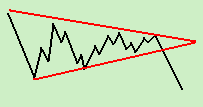
Symmetrical triangle pattern in a downtrend
"Bearish"

|

 |
 |
|
 |
 |
The three most commonly used Triangles are symmetrical, ascending and
descending. Each type of triangle has a slightly different shape and different
forecasting ability. Triangles are effective technical analysis tools useful in
both uptrends and downtrends.
The symmetrical triangle pictured below shows two converging trendlines. Note
the upper line is descending while the lower line is ascending. To the left is a
vertical line called the base. The base measures the height of the pattern. The
apex is located where the trendlines converge. The symmetrical triangle is also
referred to as a coil.
The ascending triangle, seen below, has a rising lower line and a horizontal or
flat upper line. This is generally a bullish pattern.
The descending triangle is the opposite of the ascending with a horizontal lower
line and a descending upper line. This is generally a bearish pattern.
There are measuring techniques specifically used for triangles. In the case of
the symmetrical triangle, there are two. The most commonly used is the simplest
technique of measuring the height of the vertical line at the base (the widest
point, marked A to B). The height measurement at the base is then projected from
the breakout point. Marked as #1 on the graph below.
The second method is to draw a trendline, or channel line, from the top of the
the base, point A, parallel to the lower trendline. This line then becomes the
upside target in an uptrend. This measurement makes it possible to estimate a
time target for ascending prices to meet the upper channel line. It's not
unusual for the prices to hit the new upper line at the same time the two
original trendlines converge at the apex.
A symmetrical triangle has a time limit, which is the point where the two lines
intersect forming the apex. The general rule is prices will breakout in the
direction of the prior trend usually between tw0-thirds and three-quarters of
the horizontal width of the triangle. The horizontal width is the distance from
the vertical base on the left to the apex on the right. Knowing the two lines
will meet, the time distance can be measured once the two converging lines are
drawn. See the graph below. Note an upside breakout is signaled by the
penetration of the upper trendline. If prices fail to breakout of the triangle
by the three-quarter mark, the triangle loses potency and prices will, usually,
then continue on out the apex and beyond.
The symmetrical triangle provides a combination of time and price. The
converging trendlines set a price boundary and indicate at which point this
pricing pattern will be completed by the penetration of the trendline. The upper
line in the case of an uptrend, and the lower line in the case of a downtrend.
However, the trendlines also give us a time target when we measure the
horizontal width. For example, if the width ran 20 weeks, the the expected
breakout point would be 13 (two-thirds) to 15 (three-quarters) weeks.
The actual trend signal occurs with a closing penetration of one of the
trendlines, with an occasional return move back to the penetrated line after
breakout. In an uptrend, the line that is broken becomes the support level. In a
downtrend, the penetrated line becomes resistance. The apex will also becomes an
important support and resistance level after a breakout.
The symmetrical triangle, or coil as it is sometimes known, is usually a
continuation pattern which represents a pause in an existing trend. After the
symmetrical triangle, the trend resumes its original direction. The graph below
shows the trend prior to the triangle is up, so it is assumed that the trend
will remain an uptrend after the symmetrical triangle.
A triangle requires a minimum of four reversal points because each trendline
requires 2 points. Looking at the above graph, the triangle begins at point 1
which is where the consolidation begins in the uptrend. Prices pull back to
point 2 and rally to point 3, which is lower than point 1. Once the prices
decline from point 3, the upper trendline can be drawn.
Point 4 is higher than point 2. The lower up slanting trendline cannot be drawn
until prices rally from point 4. Only when the four reversal points have been
established can our trader deduce he or she is dealing with a symmetrical
triangle.
|